Delivering locally | Shipping nationally

Contact Us: (706) 371-3388
Delivering locally | Shipping nationally
Inspection and Care of Synthetic Web Slings
Prior to use, make certain that each sling meets the requirements of your Purchase Order and that it has not been damaged in shipment.
INSPECTION
A. Cuts on face or at edge of webbing.
B. Holes, tears, snags or crushed web.
C. Excessive abrasive wear.
D. Excessive pitting or corrosion, cracked, distorted or broken fittings.
E. Broken or worn threads in the stitch patterns.
F. Melting or charring of any part of the sling.
G. Acid or caustic burns.
H. Other visible damage which causes doubt as to the strength of the sling.
OPERATING PRACTICES
WARNING: WEB SLINGS CAN BE CUT BY CONTACT WITH SHARP OR UNPROTECTED LOAD EDGES. PADDING MUST BE USED TO PROTECT THE SLINGS.
A. Determine that the weight of the load is within the rated capacity of the sling.
B. Select a sling having suitable characteristics for the type of load, hitch and environment
C. Slings shall not be shortened or lengthened by knotting or other unapproved methods.
D. Damaged slings shall not be used.
E. Slings shall be hitched in a manner providing control of the load.
F. Sharp edges in contact with slings should be padded.
G. Keep all portions of the human body from between the sling and the load, and from between the sling and the lifting hook.
H. Personnel should stand clear of the suspended load.
I. Personnel shall not ride the sling.
J. Shock loading should be avoided.
K. Slings should not be pulled from under a load when the load is resting on the sling.
L. Slings should be stored in an area where they will not be subjected to mechanical damage, moisture, extreme heat or ultraviolet light.
M. Twisting of slings shall be avoided.
N. Loads applied to the hook should be centered in the base of the hook to prevent point loading on the hook.
O. Before lifting, make certain that the sling, attachments, or load shall not snag. Personnel shall be continuously alert to avoid snagging or bumping.
P. In a basket hitch, the lifting hook should be above the center of gravity and the load balanced to prevent slippage out of the sling.
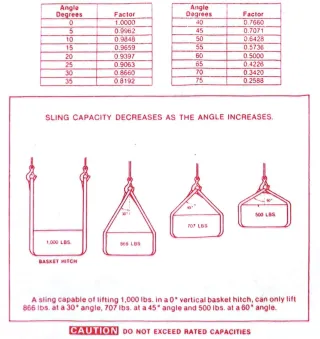
Q. When making a multiple leg lift, the capacity rating of each sling must be downgraded in accordance with the Effect of Angle Chart.
R. Slings should not be dragged on the floor or over an abrasive surface.
S. In a choker hitch, slings with hardware shall be long enough so that the choker fitting chokes on the webbing never on the triangle.
T. Nylon and polyester slings shall not be used at temperatures in excess of 200 degrees Fahrenheit.
U. Exposure to sunlight or ultraviolet light degrades the strength of synthetic web slings.
V. Inspect slings for damage and defects prior to each use.
Additional requirements and safe operating practices are outlined in current OSHA and ANSI B30.9 regulations.
EFFECT OF ANGLE
When slings are used at an angle (i.e. - two slings or one sling in a basket attached to only one crane hook), sling capacity is reduced. How much it is reduced depends on the degree of the angle. You can determine whether a sling will be rated high enough if you know the angle between the sling leg and the vertical. Once you know this angle, multiply the sling's rating by the appropriate factor in the table. This will give you the sling's reduced rating.

give us a call, we'll handle the heavy lifting.


© Straps & Supplies, 2026 All rights Reserved. | Website Managed by Lux Paradoxa